Piotr the Pierogi The Most Famous Pierogi in Lemont, Pierogi Capital of Illinois
Way back when, in the autumn of 1872, somewhere over the ocean blue, a little boy named Piotr (Peter) crossed the Atlantic with his family to make a new life in a land he could only imagine.
He had nothing to his name. No toys. No treasures. Just a worn coat, a pair of boots slightly too big for his feet, and a heart full of everything he'd left behind. But Piotr was rich in the ways that mattered.
He had his Tata, Jakub, a broad-shouldered man who sang folk songs so loudly the neighbors three doors down could hear, and smiled even wider when they knocked on the wall. He had his Mama, Hanna, whose hands could turn a lump of flour and a bucket of potatoes into something that made the whole room go quiet with wonder.
Piotr dreamed of the new world. But at night, when the ship rocked and the lantern flickered low, he dreamed of something else too: Christmas Eve back home, the whole family crowded around the kitchen, steam rising from the stovetop, the smell of onions and butter curling through every corner of the house, and a platter of pierogi – fat, golden-edged, stuffed to bursting — set at the center of the table.
After a few weeks in America, the family arrived in Chicago, and Jakub grew desperate for work. He asked everyone – neighbors, strangers, men he passed on the street — where a man with strong hands and a willing heart could find steady labor. However, Chicago, in those days, was a city of a thousand languages. Polish collided with German, Lithuanian tangled with Swedish, Russian, and English, all swirled together in the streets.
One Sunday afternoon, he stumbled upon a small Polish church, Saint Stanislaus Kostka, with a kind reverend who met them at the door. The Reverend shared a lesson of shared struggle, of starting over, of needing a little grace to find your footing.
The reverend told Jakub about Lemont, a small city about thirty miles southwest of Chicago, where limestone quarries had sprung up along the river and the Illinois and Michigan Canal. The whole city of Chicago was being rebuilt after the Great Fire of 1871, and Lemont limestone was being cut and hauled to rebuild it back up. If Jakub could get his family there, he could find easy work and feed his family
So the family packed what little they had and set out for Lemont. Jakub found work at the quarries almost immediately. He came home each evening singing and set what he'd earned on the table with quiet pride.
The family settled into a rhythm: school through the week, church on Sundays, supper after harvesting what they could from the garden. Piotr had everything he needed, except a few good friends.
On special occasions, Piotr loved to help his Mama cook pierogi. He loved pressing his palms into the dough, pinching the edges just so, the rumble of the water boiling, the soft plop as each dumpling went in. As soon as they bubbled up, Piotr would make himself a plate with butter and cream and devour them. He’d end the evening watching children play outside and wonder how he himself could make a few good friends.
Lemont was full of children — that much was clear. Families had come from Germany and Poland, Lithuania and Sweden, Russia and Austria, and places Piotr had only heard of in stories. They were all in Lemont for the same reason: to start a new life.
But knowing someone is just like you and knowing how to talk to them are two different things. At the end of the day, he walked home alone, scuffing his boots, wondering if he would always feel like a visitor in a town that wasn't quite his yet.
Then one evening after dinner, he had an idea.
“What if I could share pierogi with the other kids?”
The next day, he carried a handkerchief tied around three pierogi to school. Otto, a German boy with a gap-toothed smile and suspicious eyes, wandered close and stared at him.
Piotr stared back.
Otto pointed at the handkerchief.
Piotr looked down at it. Then back up at Otto.
Then, without quite knowing why, he held one out.
Otto took it. Sniffed it. Bit into it. His eyes went wide. He chewed slowly. Then he looked at Piotr with an expression that was not quite suspicion but the warmth of friendship. Piotr gave him another one.
And just like that, they were friends.
After that, Piotr never left the house without his pockets full of pierogi. Mama would raise an eyebrow when she saw his coat bulging. She’d shake her head but always made sure that Piotr Wiśniewski had enough.
Piotr developed a system. When he spotted a child he didn't know, he'd walk straight up to them. He couldn't always say hello. He couldn't always explain who he was or where he was from or what he liked. But he could pull a pierogi from his pocket and hold it out, and that seemed to say everything that needed saying.
His new friends came from everywhere. Otto, who could whistle louder than anyone in Lemont. There was Birgitta, a Swedish girl who could beat every boy in the neighborhood at a footrace. There was Aleksas, a Lithuanian boy whose grandmother made something called cepelinai that Piotr tried once and decided was possibly even better than pierogi, though he would never in his life admit that out loud.
One by one, Piotr, whose pockets were stuffed with pierogi, collected friends around the neighborhood. Everywhere in Lemont, people smiled and pointed and called out:
There is Piotr the Pierogi! There goes Piotr the Pierogi!
Piotr grew up in Lemont and eventually worked in the quarries like his father. He later opened a small shop and married a girl from the neighborhood — Birgitta, as it turned out, who still ran faster than everyone.
What people remembered most, what got passed down from generation to generation, was
a boy with his pockets full of dumplings and a stubborn belief that if you gave someone something warm and good, something you made with your own hands and brought from far away, you didn't need to speak the same language to understand each other.
You just needed to take the bite.
And that, they say, is how Lemont became the Pierogi Capital of Illinois — one pocket, one dumpling, one friend at a time.
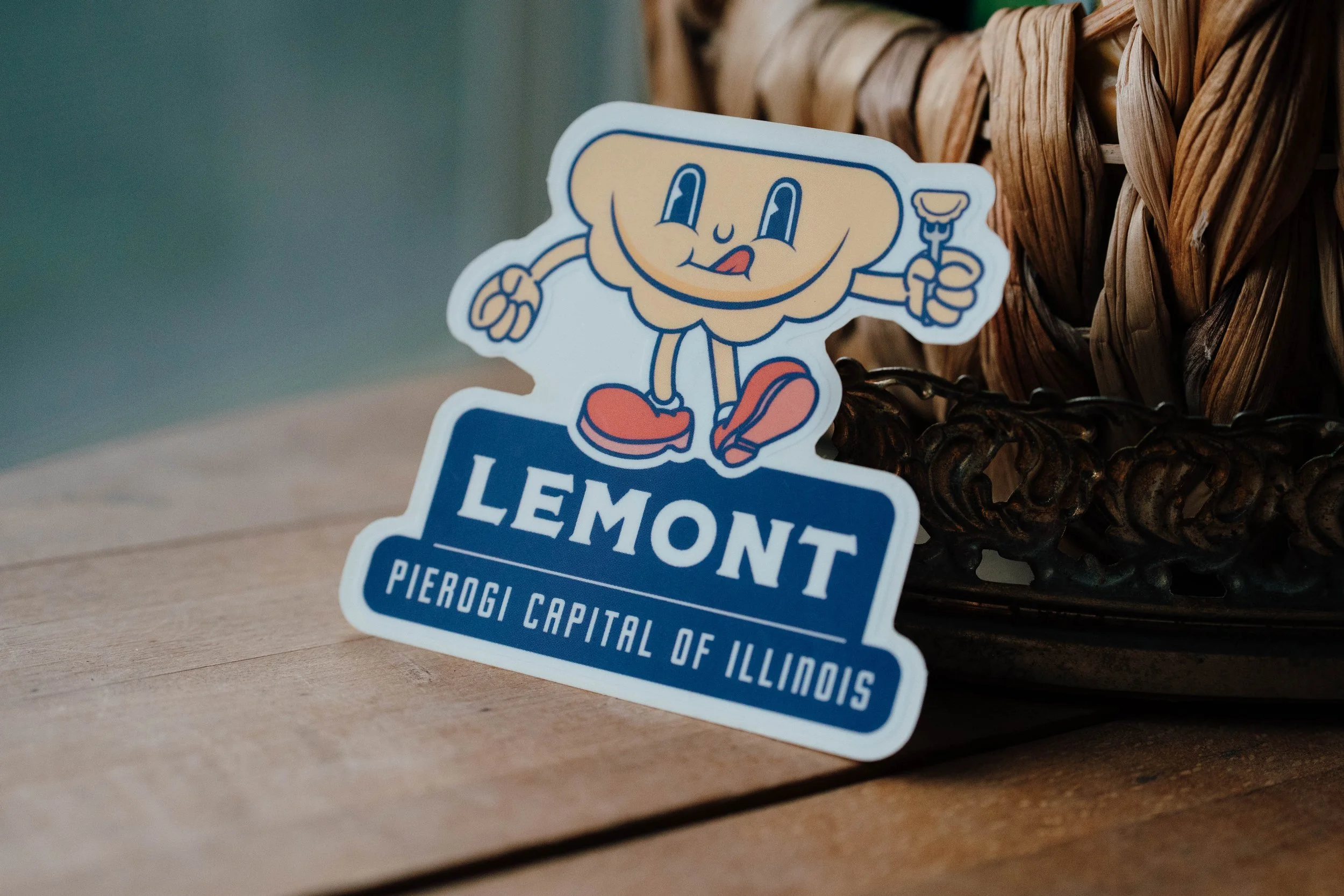
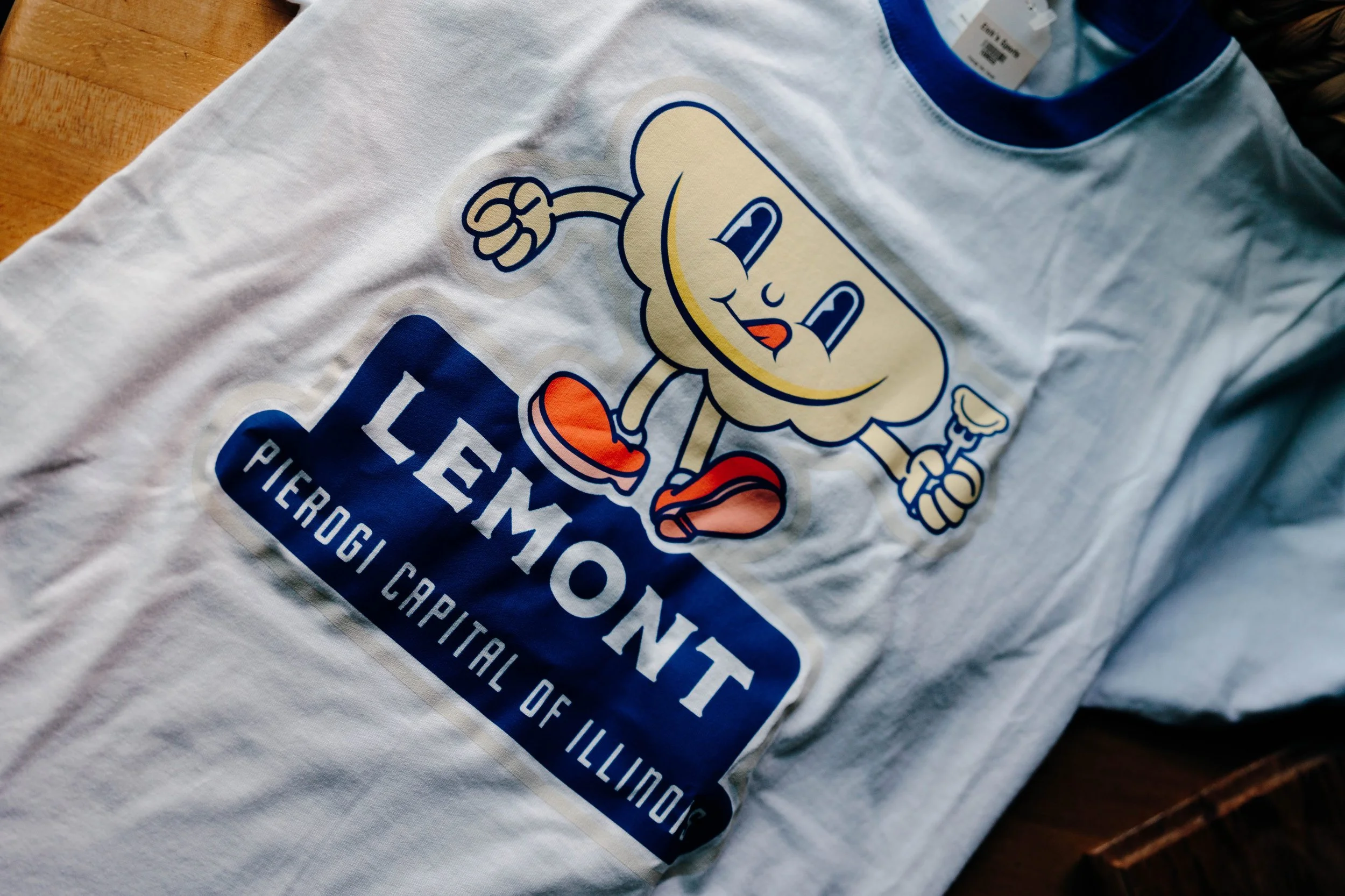
Grab your Piotr the Pierogi Shirt at Eich’s Sporting Goods in store or online and find stickers at upcoming events.